
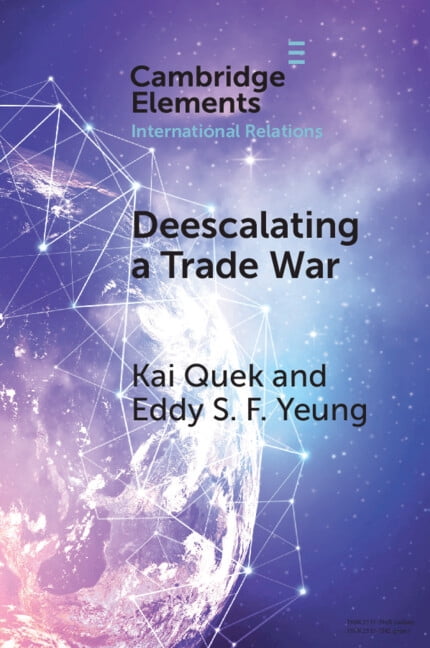
Elements in International Relations Deescalating a Trade War: Strategies of Reciprocation Amid Us-China Great Power Competition, (Paperback)
Product details
| Management number | 238741223 | Release Date | 2026/07/11 | List Price | US$10.00 | Model Number | 238741223 | ||
|---|---|---|---|---|---|---|---|---|---|
| Category | |||||||||
Reciprocation is central to conflict deescalation. How a country reciprocates-and how its domestic public and international rival respond to its reciprocation-can play an important role in shaping the trajectory of conflicts. Moving beyond conventional understandings in international relations that focus on balanced reciprocity between states, we propose two additional general forms of reciprocation: semi-reciprocity (reciprocation perceivably less than received) and super-reciprocity (more than received). We situate our theory in a hard case for deescalation, the US-China trade war, where relative-gains concerns are salient amid great power rivalry. Employing novel dyadic experiments that capture strategic interactions between states, we show, for the first time, how different strategies of reciprocation shape the domestic feasibilities of deescalation. The findings reveal how different forms and sequences of reciprocation shape the prospect of rapprochement, shedding light on the public dynamics underlying different pathways of deescalating a trade war that has profoundly impacted the world.
- Elements in International Relations Deescalating a Trade War: Strategies of Reciprocation Amid Us-China Great Power Competition, (Paperback)
- Author: Kai Quek
- ISBN: 9781009659215
- Format: Paperback
- Publication Date: 2026-08-31
- Page Count: 75
| Book format | Paperback |
|---|---|
| Fiction/nonfiction | Non-Fiction |
| Genre | Political & Social Sciences |
| Publication date | July, 2026 |
| Pages | 75 |
| Subgenre | International Relations |
| Series title | Elements in International Relations |
| Number in series | 0 |
| Edition | 1 |
| Publisher | Cambridge University Press |
| Language | English |
| Is collectible | N |
| Recording time | 0 min |
| Retail packaging | Single Piece |
| Assembled product dimensions (l x w x h) | 0.75 x 6.00 x 9.00 in |
| Assembled product weight | 1.25 lb |
| Bisac subject heading | Political Science |
Bestseller ranking
All Books




Customers who viewed this product also viewed
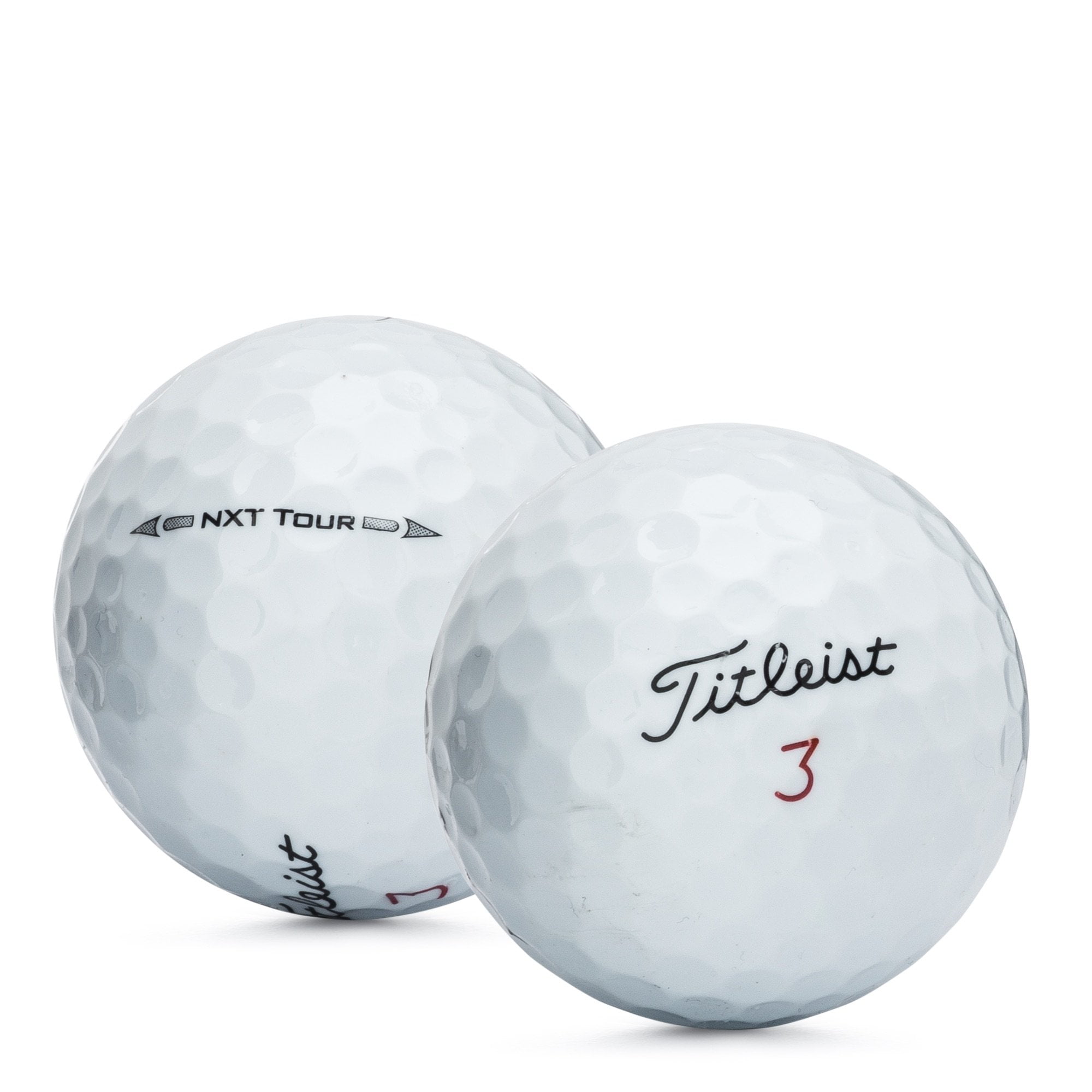
Used Golf Balls
Correction of product information
If you notice any omissions or errors in the product information on this page, please use the correction request form below.
Correction Request Form